
Highland Cattle Coat Colour Genetics Explained
Highland Cattle Hair Colours
There are seven recognized Highland cattle hair colors:
Red, Black, Brindle, Dun, Silver dun, Yellow and White
Originally, Highland cattle came in only two colors:
Red
Black
Through breeding, scientists later identified a dilution gene that alters these base colors.
The Dilution Gene
The dilution gene affects how strong the red or black pigment appears.
With one dilution gene
Red → Yellow
Black → Dun
With two dilution genes
Red → White
Black → Silver Dun
Silver dun cattle typically have:
Grey pigment on the nose
Black pigment on hooves
Black pigment on horn tips
White cattle typically have:
Pink pigment on the nose
White/natural pigment on hooves
White/natural pigment on horn tips
Genetic Rules
Some color combinations cannot produce certain offspring colors:
Two red parents cannot produce dun or silver dun calves
White or yellow parents cannot produce dun or silver dun calves
Other tendencies include:
Brindle parents have a higher chance of producing black offspring
Red Highlands often have small black hairs around the face, neck, and legs, which is necessary for brindle patterning
Coat Color Changes as Calves Grow
Highland calves often change color as they mature. Some Highlands may also show highlights in their coat. These highlights can appear on the tail, along the backline, in the dossan, or scattered throughout the coat
Common examples:
Black and dun calves are often born chocolate brown
Their true color becomes visible around 8–12 months
The muzzle pigment is often the best indicator of their final color
Other changes:
Red and yellow calves can look very similar at birth. White and yellow calves can be difficult to distinguish when they are newborn
Coat Hair Colour Charts for Highland Cattle
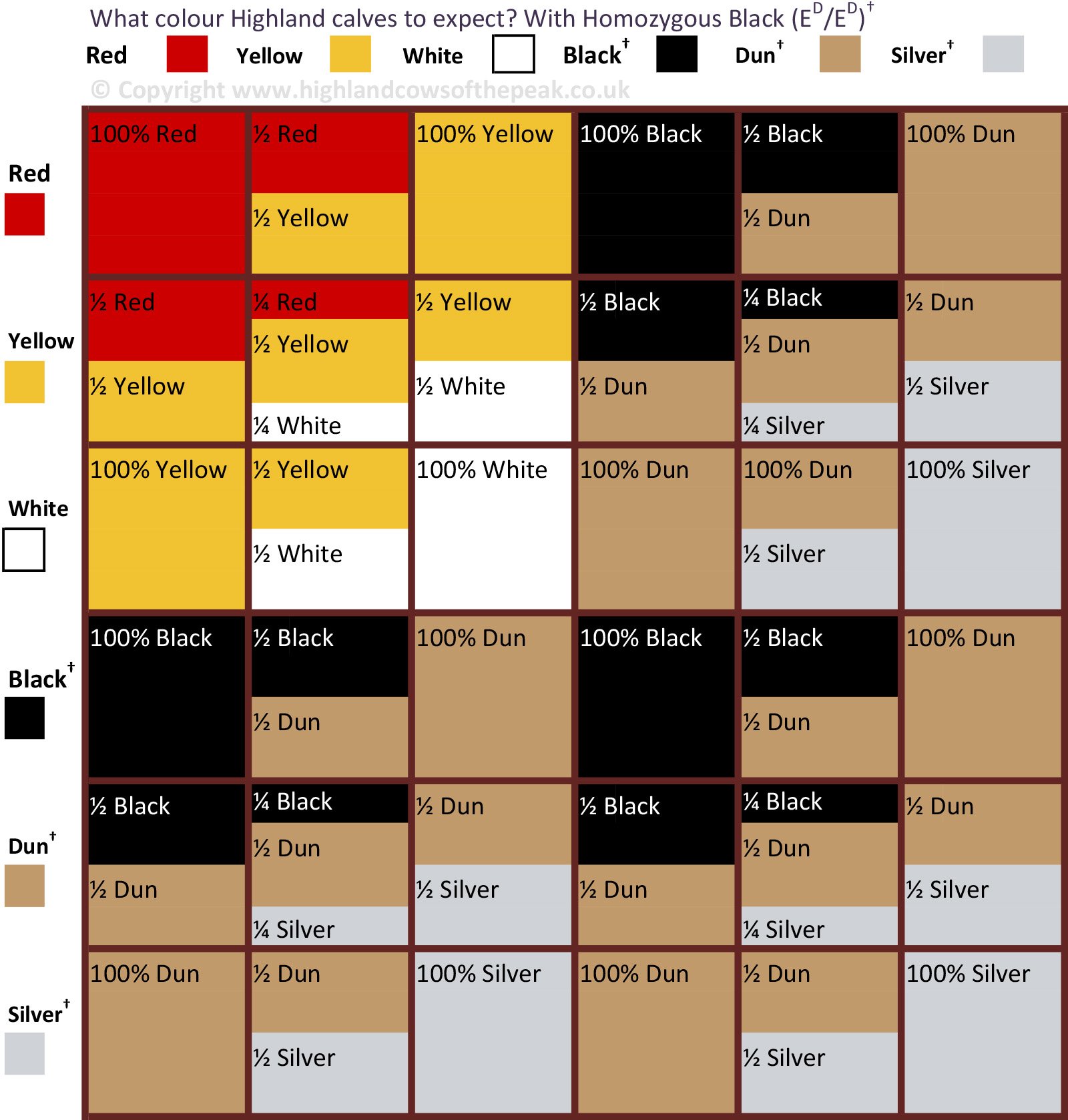
What colour Highland calves to expect? With Homozygous Black (Eᴰ/Eᴰ)†
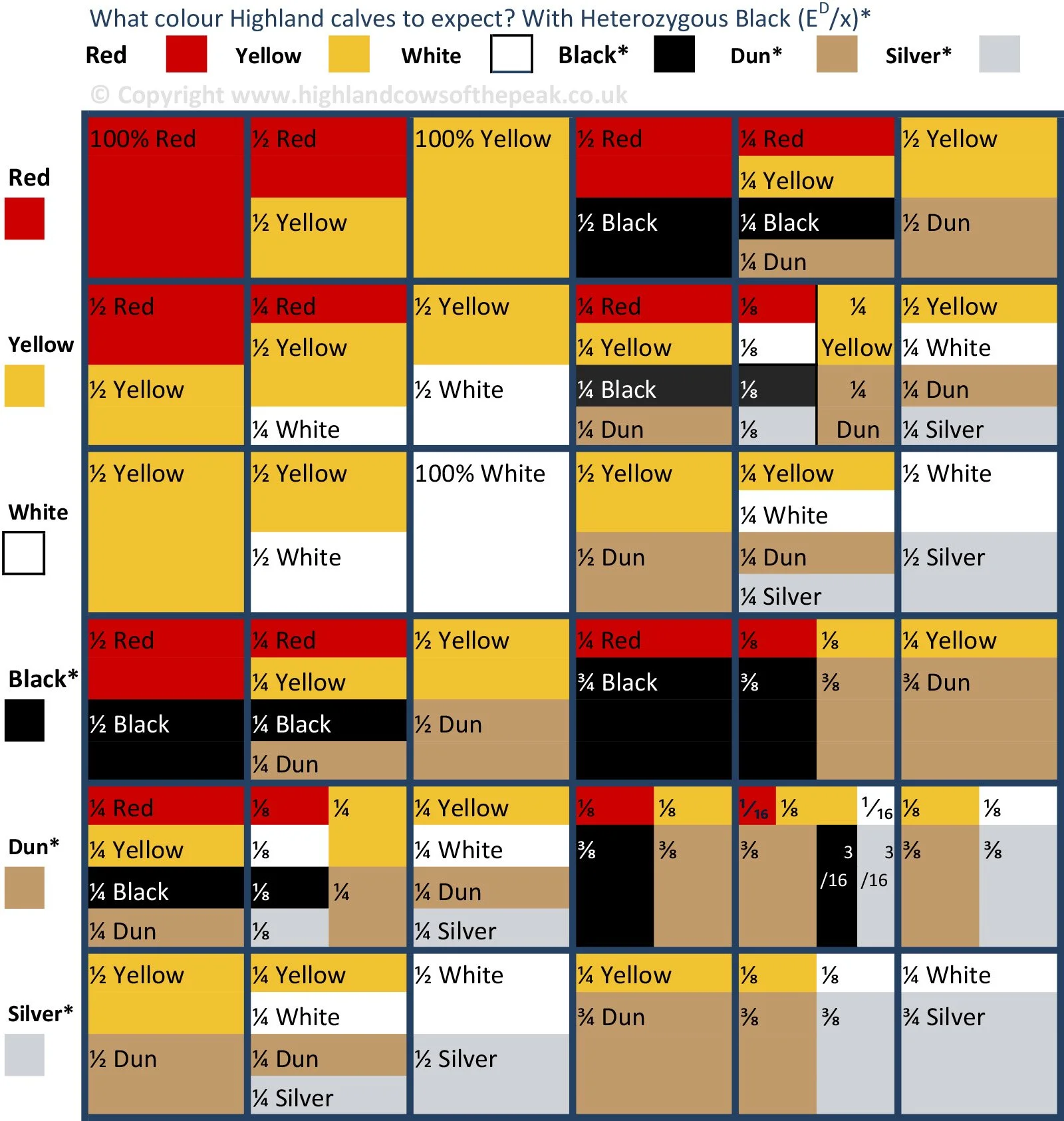
What colour Highland calves to expect? With Heterozygous Black (Eᴰ/x)*
Homozygous vs Heterozygous
The terms homozygous and heterozygous describe the two alleles (gene versions) an animal has at a specific gene locus. Every animal receives one allele from the sire and one from the dam
Homozygous
Homozygous = same gene twice
Examples in Highland colour genetics:
e / e → red coat
DH / DH → double dilution (white or silver dun)
+ / + → no dilution
Because both alleles are identical, the animal will always pass that same gene to its calves.
Example:
A white Highland (DH/DH) will always pass a DH dilution gene.
Heterozygous
Heterozygous = two different genes
Examples:
ED / e → black (because black is dominant)
DH / + → single dilution (yellow or dun)
These animals can pass either allele to their offspring.
Example:
A yellow Highland (DH/+) could pass:
DH → dilution
+ → no dilution
So the calf colour becomes less predictable.
Chromosomes and Genes in Cattle
All cattle have 30 pairs of chromosomes (60 total).
These chromosomes are long strands of DNA that contain thousands of positions called loci (singular: locus).
Each locus contains genes that control specific traits, such as:
Coat colour
Horn shape
Temperament
Growth
Meat marbling
Most genes are the same in all cattle breeds, because they control basic features that make cattle different from other animals.
However, a small number of genes differ, and these differences create variation between breeds and individuals.
Coat Colour Genetics
Coat colour in cattle is not controlled by just one gene.
Instead, there are six major colour loci that interact to determine the final coat colour. There are also several minor loci that can modify the appearance.
These six major loci are believed to exist in most mammals, which is why similar colour genetics appear across many species.
Each locus can contain different versions of a gene, called alleles.
Different combinations of these alleles produce the wide range of colours seen in Highland cattle.
Because multiple loci interact, coat colour genetics becomes complex and sometimes difficult to predict.
What Is “Wild Type” Colour?
The term wild type refers to the original or default colour pattern found in wild ancestors.
For cattle, the wild type colour is believed to be similar to the colouring of the ancient European aurochs, the ancestor of many British cattle breeds.
This colour was roughly:
Red-brown body
Darker shading in some areas
Many other coat colour genes are dominant over this wild type base colour.
Genetic Naming System
Geneticists use a standard system to describe colour genes.
1. Locus Names
Each locus has a letter representing it.
Example:
D locus = dilution gene
2. Allele Symbols
Alleles are written using the locus letter plus a symbol.
Example at the E locus (Extension locus):
Eᴰ = Black colour gene
E⁺ =Wild type colouring
e = Red colour gene
3. Dominant vs Recessive
Capital letters = dominant genes
Lowercase letters = recessive genes
Example:
Eᴰ (dominant black)
e (recessive red)
4. Two Alleles Per Locus
Each animal inherits two alleles at every locus, one from each parent.
They are written with a slash between them.
Examples:
Eᴰ / Eᴰ → black
Eᴰ / e → black (dominant)
e / e → red
Why Highland Colour Genetics Is Complex
Colour in Highlands depends on interactions between several loci, including:
E locus – controls black vs red pigment
D locus – dilution (yellow, dun, white, silver dun)
A locus – brindle pattern (when E+/e or E+/E+)
Other modifier loci
Because of these interactions:
Some colours cannot appear in certain parents
Some calves change colour as they grow
Some genes remain hidden for generations
Highland Coat Colour Oddities
Whilst there are 7 different colours, in the UK you can also register the rare parti colour so there are in fact eight officially registerable Highland coat colours in the UK Herd Book, some animals show unusual colour patterns that fall outside the normal categories. These likely reflect the wide genetic diversity in the breed’s early history.
These traits add interest to breeding Highlands but also make coat-colour genetics more complex.
Mahogany (“Frosting”)
Mahogany is a dark red coat colour with distinctive white-tipped hairs. Most noticeable, especially on the dossan, tip of the tail and variable amounts along the topline and mane. Very striking in young calves, but the contrast usually fades as the animal matures. Some breeders also call it “frosting” because of the frosted hair tips.
Bus Dubh (Black Muzzle Ring)
Bus Dubh is a traditional Highland trait where the animal has a ring of short black hairs around the muzzle.
Characteristics
Only appears in red Highland cattle
Forms a dark ring around the nose
Intensity can vary:
between seasons
between years
Bus Geal (White Muzzle Ring)
Bus Geal is a less common Highland trait where the animal has a ring of short white hairs around the muzzle.
Characteristics
Forms a light ring around the nose
Intensity can vary:
between seasons
between years
Interesting points
Seen more often in cows than bulls
Some breeders believe it may be linked to the brindle gene
It is often considered a historic Highland characteristic, rarely seen in other cattle breeds
The name Bus Dubh comes from Gaelic, meaning “black muzzle.”
Parti Colour
Parti colour is a fairly rare pattern where a Highland has white patches combined with a solid colour (usually red or yellow).
Possible genetic origin
Research into pedigrees suggested many parti-coloured animals traced back to two ancestors: a bull, Sgaithanach, and a cow, Rosie (around 1870) This suggests the trait may follow a simple recessive inheritance pattern, since it can appear unexpectedly from carrier parents.
White Udders
A white udder in Highland cattle is a common marking where white hair or skin appears on the udder and sometimes extends toward the navel, is acceptable within breed standards if it does not go past the navel, occurs in up to about 50% of herds, and is thought to be caused by a gene related to white spotting, possibly linked to the same locus as the parti-colour gene. 🐂🧬